AI influencers: how they’re made, model by model.
One invented face, posted hundreds of times without ever changing. Here is the full pipeline behind an AI influencer — the stages, the models used at each one, and a real persona we built for $2.25 to prove it.
- 6 stages
- 20+ models named
- Real prompts & costs
Design your AI influencer in two minutes.
Describe the character and the builder writes the prompts, picks the model stack and lays out a posting week. Everything runs in your browser — copy the output into the tools you already use.
1 Base portrait prompt
Text-to-image. Generate a few, keep the one face you love — it becomes the reference for everything else.
2 Scene prompts attach the base portrait as reference
| Stage | What to use |
|---|
Profile bio
The “AI-generated” line is deliberate: platforms expect realistic AI content to be labeled, and audiences forgive a virtual creator far more easily than a hidden one.
Persona brief paste into any LLM to write captions in character
How AI influencers are created, stage by stage.
Every image and clip below is the same fictional persona. Nothing was retouched; the prompts, models, times and prices are exactly what we ran.
- 01
Write the persona before the pixels
The accounts that last start as a character sheet, not an image. Decide the niche, the voice and one signature item people will recognise at thumbnail size. Ours: a fashion creator, warm and unhurried, never seen without a mustard bomber jacket.
- Name
- Mira
- Niche
- Everyday fashion
- Voice
- Warm, first-name basis
- Signature
- Mustard bomber jacket
- Never
- Claims to be human
- 02
Generate the base portrait
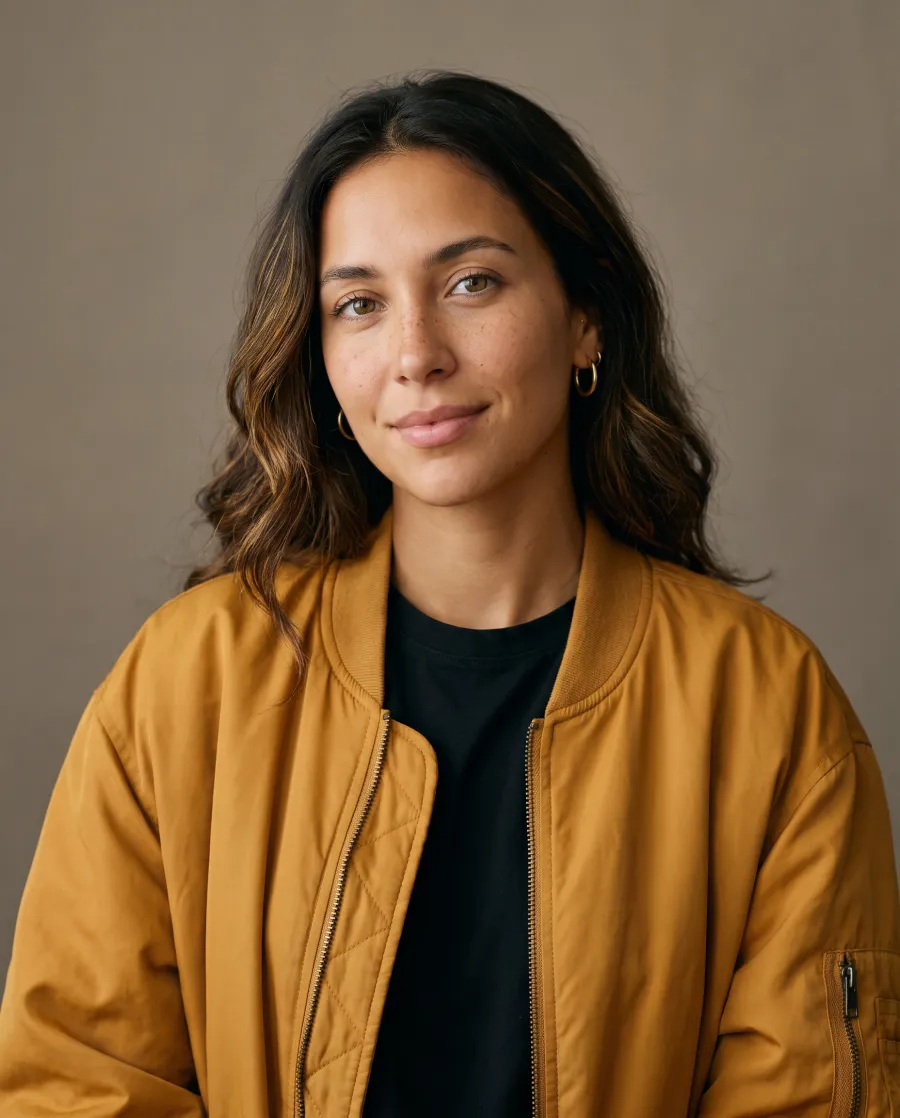
A text-to-image model invents the face. Describe skin, hair, eyes and one or two imperfections — freckles, a scar, a gap tooth — because flaws are what make a face look photographed. Generate several and keep exactly one: it becomes the reference for everything that follows.
Show the exact prompt
Photorealistic editorial portrait of a fictional 27-year-old woman, a virtual fashion creator: warm olive skin, shoulder-length wavy dark-brown hair with subtle golden highlights, light freckles across the nose, hazel eyes, small gold hoop earrings. She wears a mustard-yellow oversized bomber jacket over a plain black t-shirt. Soft natural smile, looking directly at the camera. Upper-body shot, plain warm-grey studio backdrop, soft window light from the left, 85mm lens, natural skin texture with visible pores, no heavy retouching.
Base portrait - 03
Lock the identity
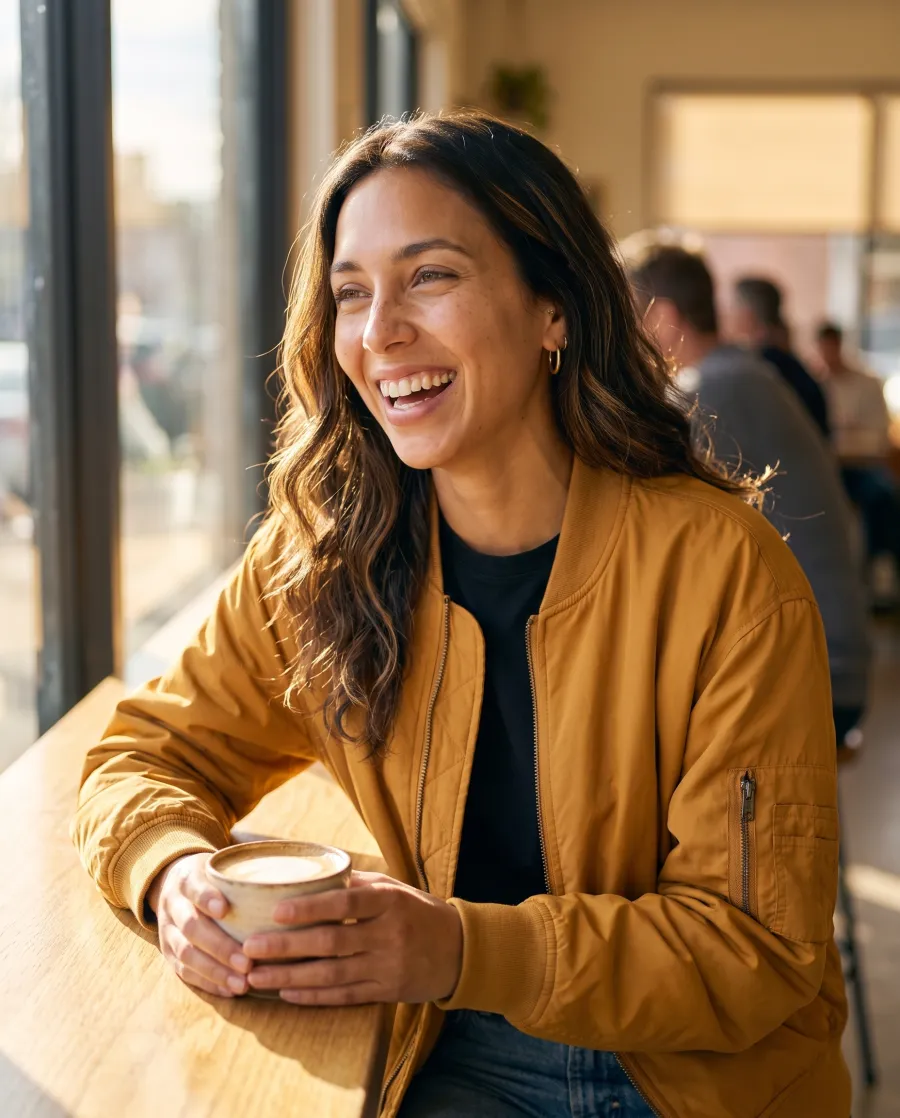
This is the stage that separates an AI influencer from a pile of pretty pictures. Every new image is conditioned on the base portrait so the face, freckles and hair survive a change of scene. There are three ways to do it:
- Reference-image editing — pass the portrait in with a new scene prompt. Fastest; what we used.
- LoRA fine-tune — train a small adapter on 15–30 images. Best for hundreds of posts.
- Face adapters — IP-Adapter, InstantID or PuLID inject the face into open-source pipelines.
Show a scene prompt
The same woman as in the reference image — identical face, freckles, hazel eyes, wavy dark-brown hair with golden highlights and small gold hoop earrings. She sits at a sunlit café table by a window holding a flat white in a ceramic cup, wearing the same mustard-yellow bomber jacket over a black t-shirt, laughing candidly and looking slightly off camera. Shot on a phone, shallow depth of field, warm morning light, photorealistic lifestyle photo.
Café 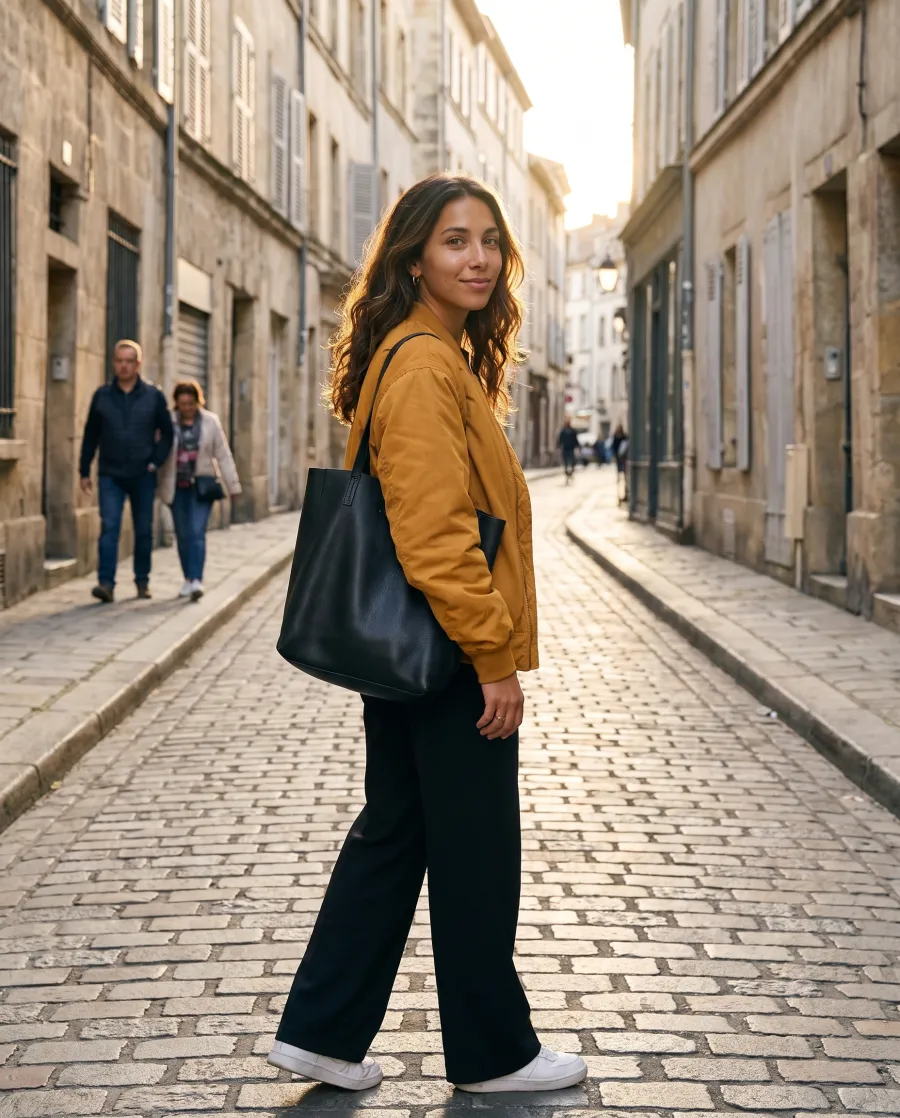
Street 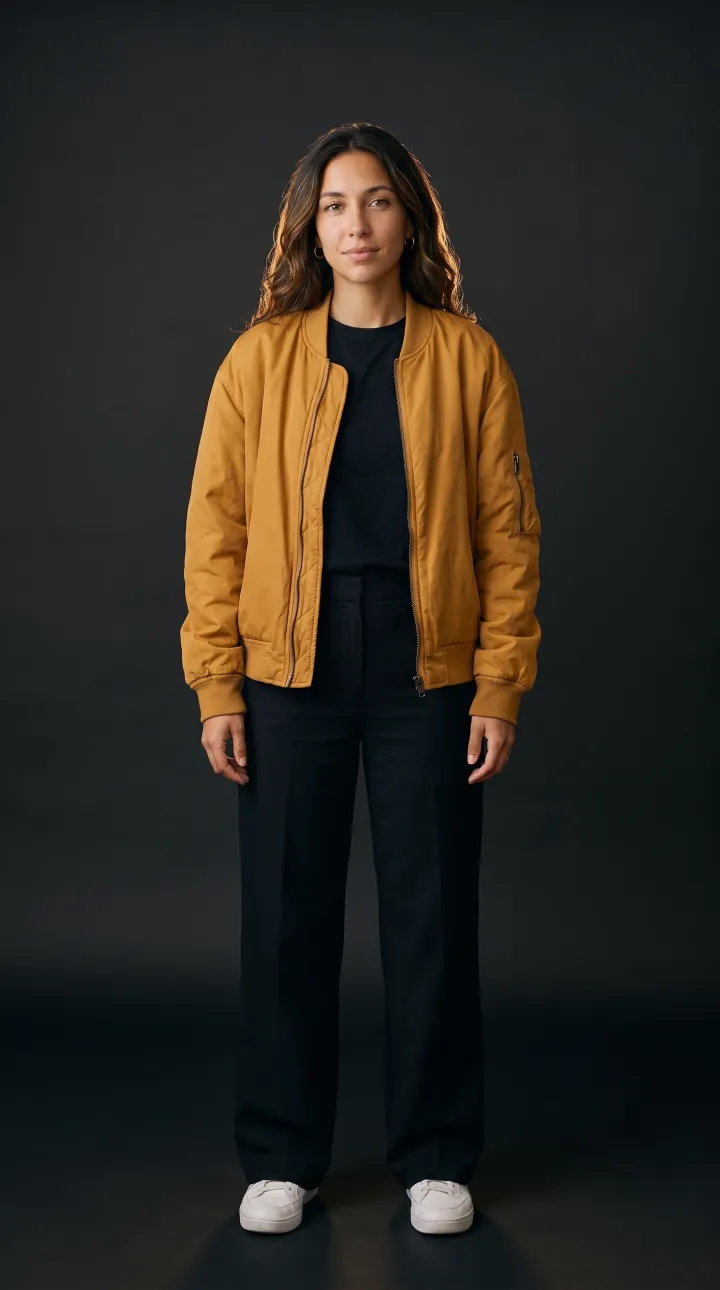
Full body - 04
Make it move
Stills build the grid; video builds the audience. Three kinds of model turn a photo into a clip:
- Motion transfer — copies a dance or gesture from a reference video onto the full-body image.
- Image-to-video — animates a still into b-roll: a turn of the head, a walk, steam off a coffee.
- Lip-sync — drives the portrait’s mouth and head from an audio track for talking clips.
Reference dance Her reel - 05
Give it a voice
Talking clips need two more models: text-to-speech for the voice, and an LLM to draft scripts and captions in character. Design the voice once and reuse the same voice ID forever — a changing voice breaks the illusion faster than a changing face. Keep a short persona brief and paste it into every writing session.
- 06
Publish, label, repeat
Batch a week of content in one sitting, schedule it, and spend the saved time in the comments — replies are still written by a human. Label the account and the posts as AI-generated from day one; it is required on the major platforms and it is what keeps brand deals possible later.
- Mon
- Photo · café
- Wed
- Dance reel · trend
- Fri
- Photo · street style
- Sun
- Talking clip · one tip
Which AI models are used at each stage.
No single model makes an AI influencer. It is a relay: each stage hands its output to the next. These are the models creators reach for most in late 2026.
| Stage | Job | Models commonly used |
|---|---|---|
| Character design | Text-to-image: invent the face, body and style | Nano Banana Pro (Gemini 3 Pro Image), Seedream 5, GPT Image 2, FLUX.2, Midjourney |
| Identity consistency | Keep one face across hundreds of images | Reference-image editing (Nano Banana Pro, Seedream edit), LoRA fine-tunes on FLUX or SDXL, face adapters such as IP-Adapter, InstantID and PuLID |
| B-roll video | Image-to-video: bring a still photo to life | Kling 3.0, Seedance 2.5, Wan 3.0, Veo 3, Runway Gen-4.5 |
| Dance & motion transfer | Copy the moves from a reference clip | Kling 3.0 Motion Control, Wan 2.2 Animate, Seedance 2.5 Reference |
| Talking clips | Lip-sync a portrait to an audio track | Wan-S2V, Live Avatar, OmniHuman, avatar tools such as HeyGen and Hedra |
| Voice | Text-to-speech and voice design | ElevenLabs v4, Gemini TTS, open models such as MOSS-TTS, Kokoro and Chatterbox |
| Scripts & captions | Write in the persona’s voice | Any capable LLM — Claude, GPT or Gemini — primed with a persona brief |
Model names are trademarks of their owners. The list reflects what is widely available, not an endorsement.
From CGI characters to generated creators.
Virtual influencers are a decade old. What changed is that one person can now do what once took a studio.
CGI character
Lil Miquela
Launched on Instagram by the Los Angeles studio Brud. Built with traditional 3D and compositing, years before generative image models were usable.
3D-modelled
Shudu
Created by photographer Cameron-James Wilson and often described as the first digital supermodel. Each image was hand-built in 3D software.
Generative AI
Aitana López
Made by the Barcelona agency The Clueless with AI image tools — the template most of today’s AI influencers follow.
Four things that keep the account alive.
Most AI influencer accounts that disappear broke one of these. General information, not legal advice.
Label it as AI
TikTok and YouTube require creators to disclose realistic AI-generated content, and Meta adds “AI info” labels on Instagram. In the EU, the AI Act adds transparency duties for synthetic media. Put “AI-generated” in the bio and use the platform toggle.
Disclose paid posts
Sponsorship rules apply to virtual creators too. In the US, the FTC’s endorsement guidance explicitly covers virtual influencers — mark ads as ads.
Invent the face
Design a fictional adult. Never build a persona on a real person’s face, a celebrity look-alike or anyone who hasn’t agreed in writing.
Don’t fake expertise
A virtual creator can share opinions and style, not medical, legal or financial credentials it doesn’t have.
You have the face. Now make the content.
The full-body pose from your builder output is all these need.
Trend & dance reels
Drop the full-body pose into a dance template and post while the sound is climbing.
Dance effects on FIKKU ↗ (opens in a new tab)Product & UGC ads
FIKKU’s AI UGC tool makes 5–10 second product videos with AI actors — or your own persona photo as the actor.
AI UGC on FIKKU ↗ (opens in a new tab)Any reference clip
Have a specific move or meme in mind? Motion transfer applies any clip to your character.
Motion transfer on FIKKU ↗ (opens in a new tab)Duets & templates
Pair your persona with a second character in trend templates like Hotel Lobby.
Hotel Lobby AI guide →
AI influencers, answered.
The questions people ask before they build their first one.
What is an AI influencer?
An AI influencer is a fictional social media persona whose photos, videos and often voice are generated with AI models instead of being filmed. A person or team still decides the personality, writes or approves the posts and runs the account.
How are AI influencers created?
In six stages: define the persona, generate a base portrait with a text-to-image model, lock the identity so the same face appears in every image, produce photo sets, turn stills into video with image-to-video, motion transfer or lip-sync models, then add a voice and publish with an AI label.
Which AI models are used to make AI influencers?
Image models such as Nano Banana Pro, Seedream, GPT Image, FLUX and Midjourney create the character. Reference-image editing, LoRA fine-tunes and face adapters keep it consistent. Kling, Seedance, Wan, Veo and Runway handle video, Kling Motion Control and Wan Animate handle dance, lip-sync models like Wan-S2V and OmniHuman make talking clips, and ElevenLabs or open TTS models provide the voice.
How do AI influencers keep the same face in every post?
By conditioning every new image on the original. The quick way is reference-image editing: the base portrait goes in with a new scene prompt. For large volumes, creators train a LoRA on 15–30 of their best images. A recognisable signature item — a jacket, glasses, a hairstyle — hides the small differences that remain.
How much does it cost to make an AI influencer?
The example persona on this page cost $2.25 in API fees: four images at $0.14 each and one 10-second dance reel at $1.69. Ongoing cost scales with how much you post; video is the expensive part.
Can I create an AI influencer for free?
You can plan one for free with the builder on this page, and several tools offer free trial credits — FIKKU gives 10 on signup. Producing regular content, especially video, requires paid generations.
Do I have to say my influencer is AI?
Yes, in practice. Major platforms require labels on realistic AI-generated content and advertising rules still apply to sponsored posts. Being open about it also protects the account from being reported as deceptive.
Can I base an AI influencer on a real person?
Not without their explicit consent. Using a real person’s likeness can break platform rules and publicity or privacy law. Design an original, fictional adult instead.
The persona on this page is fictional and entirely AI-generated; any resemblance to a real person is coincidental. Prices are API costs we paid in October 2026 and will change. Product and model names belong to their owners.